
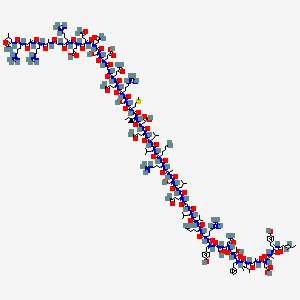
Overview
Tesamorelin (TH9507) is a synthetic analogue of naturally occurring growth hormone-releasing factor. Preclinical research examines peptide stability and growth hormone release. [1]
Identity
| Material | Growth hormone-releasing factor analogue |
|---|---|
| Also called | TH9507 |
| Reference compound | Tesamorelin |
| CAS number | 218949-48-5 |
| Molecular formula | C221H366N72O67S |
| Molecular weight | 5136 g/mol |
| Source | PubChem CID 16137828 |
Published research
Comparative pharmacology · Peptide stability
Researchers compared TH9507 with unmodified growth hormone-releasing factor, examining enzymatic inactivation and growth hormone release. The analogue showed a longer duration of activity in the experimental comparisons. Compared with unmodified growth hormone-releasing factor, TH9507 resisted enzymatic inactivation and degraded more slowly in plasma from rats, dogs and humans. [1]
Human physiology study · Pulse size and basal secretion
Investigators repeatedly sampled growth hormone overnight and used the time series to estimate basal secretion and the size of secretory pulses. They reported increases in basal secretion and average pulse area. From serial overnight measurements, the investigators found that both basal growth hormone secretion and average pulse area increased in the men studied. [2]
Where the evidence stands
The preclinical study showed that the modified peptide persisted longer than the parent factor. Human serial-sampling data showed contributions from both basal secretion and larger growth hormone pulses. The two studies address complementary questions, but the human experiment did not isolate slower degradation as the cause. [1] [2]
Frequently asked questions
Why collect serial samples in pulsatility studies?
Serial measurements show the timing and size of secretory pulses and provide an estimate of secretion between pulses.
Which measurements are discussed here?
Peptide stability and Pulse size and basal secretion.