
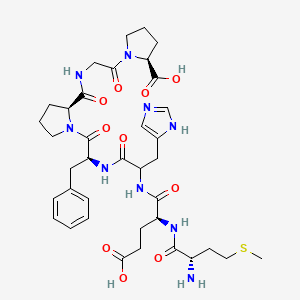
Overview
Semax is a synthetic seven-amino-acid analogue based on a fragment of the naturally occurring hormone ACTH. Preclinical research examines cortical gene expression after experimental brain ischemia. [1]
Identity
| Compound class | Synthetic ACTH-fragment analog |
|---|---|
| Length | 7 amino-acid residues |
| Reference compound | Semax |
| CAS number | 80714-61-0 |
| Molecular formula | C37H51N9O10S |
| Molecular weight | 813.9 g/mol |
| Source | PubChem CID 9811102 |
Published research
Animal study · Protein abundance
Dolotov and colleagues studied Semax binding and measured BDNF protein in rat basal forebrain. A regional tissue measurement captures the combined signal of the cells in that sample. Dolotov and colleagues found specific Semax binding and increased BDNF protein in rat basal forebrain. [1]
Animal study · Gene expression after ischemia
In a rat focal-ischemia model, investigators compared cortical gene expression with that of ischemia controls. Differences involved groups of genes linked to immune responses and vascular processes. Compared with ischemic controls, Semax-exposed rats showed changes in immune- and vascular-related gene expression, with prominent increases in immunoglobulin and cytokine transcripts at 24 hours. [2]
Where the evidence stands
One rat study found a regional increase in BDNF protein. Another found a time-dependent cortical transcriptional response after focal ischemia. Together they support measurable molecular responses in rat brain tissue. Neither outcome on its own demonstrates functional recovery. [1] [2]
Frequently asked questions
What does BDNF stand for?
Brain-derived neurotrophic factor.
What material was discussed in the cited paper?
The authors described Semax, a synthetic ACTH-fragment analog.
References
Interested in Researching Semax?
View Semax in PURUS Research Catalog.