
Overview
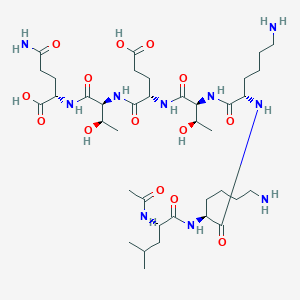
The TB-500 fragment is a synthetic, acetylated seven-amino-acid peptide based on a segment of naturally occurring thymosin beta-4. Fragment-specific studies examine peptide metabolism and gap closure in fibroblast cultures. [1]
Identity
| Reported fragment | Residues 17–23 of thymosin beta-4 |
|---|---|
| Modification in cited sample | N-terminal acetylation |
| Reference compound | TB-500 (published acetylated fragment) |
| CAS number | 885340-08-9 |
| Molecular formula | C38H68N10O14 |
| Molecular weight | 889.0 g/mol |
| Source | PubChem CID 62707662 |
Published research
Analytical study · Identifying the fragment
Researchers used chemical analysis to identify the N-terminally acetylated fragment corresponding to residues 17–23 of thymosin beta-4. This distinction matters because papers on actin binding frequently tested the entire 43-residue chain. The investigators identified the acetylated seven-residue sequence Ac-LKKTETQ in the TB-500 preparation they analyzed. [1]
Cell study · Parent fragment and metabolites
In a fibroblast scratch assay, the investigators compared the fragment with products formed during its breakdown. The parent fragment showed no significant increase in gap closure, whereas a metabolite produced greater closure under the study conditions. The investigators detected no cytotoxicity from the parent or its tested metabolites under the assay conditions. The parent fragment showed no significant increase in fibroblast gap closure relative to the control, whereas its shorter metabolite Ac-LKKTE produced a small, statistically significant increase. [2]
Where the evidence stands
Analytical evidence identifies the acetylated fragment. The biological comparison was more selective: only Ac-LKKTE increased gap closure significantly in the cited fibroblast scratch assay. That result supports further work on the metabolite rather than a claim about the parent fragment. [1] [2]
Frequently asked questions
How is the fragment related to thymosin beta-4?
The fragment corresponds to a portion of the full-length peptide.
Why check the exact name in each paper?
Authors may refer to the full-length peptide, a fragment, or a particular chemical form.
References
Interested in Researching TB-500?
View TB-500 in PURUS Research Catalog.