
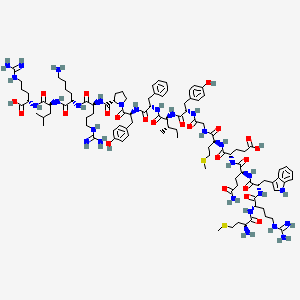
Overview
MOTS-c is a naturally occurring 16-amino-acid peptide encoded within the mitochondrial 12S rRNA region. Research examines how it relates to cellular energy metabolism and insulin sensitivity in experimental models. [1]
Identity
| Length | 16 amino-acid residues |
|---|---|
| Reported coding region | Mitochondrial 12S rRNA region |
| Reference compound | MOTS-c (free base) |
| CAS number | 1627580-64-6 |
| Molecular formula | C101H152N28O22S2 |
| Molecular weight | 2174.6 g/mol |
| Source | PubChem CID 146675088 · FDA reference |
Published research
Cell and mouse study · Metabolic signaling
Lee and colleagues traced changes in folate and purine metabolism and examined AMPK, an energy-sensitive signaling enzyme. In high-fat-fed mice, the authors reported differences in weight gain and insulin sensitivity. The authors linked inhibition of folate and purine metabolism to AMPK activation in cells and found that MOTS-c prevented diet-induced insulin resistance in the mice studied. [1]
Cell study · Movement from mitochondria to nucleus
A subsequent study found that metabolic stress was associated with AMPK-dependent movement of MOTS-c into the nucleus. Under glucose restriction, investigators observed interactions with stress-responsive transcription factors including NRF2 and changes in genes associated with antioxidant response elements. The researchers found that metabolic stress triggered AMPK-dependent movement of MOTS-c into the nucleus, where it interacted with NRF2 and regulated stress-responsive genes. [2]
Where the evidence stands
The cell studies connect MOTS-c with energy sensing at two levels: metabolic changes associated with AMPK activation and AMPK-dependent movement of the peptide into the nucleus. Mouse data also showed protection against insulin resistance. The nuclear experiment did not establish how much of the whole-animal response that pathway explains. [1] [2]
Frequently asked questions
What is an open reading frame?
A stretch of nucleotide sequence with the potential to encode a peptide or protein.
Why is the mitochondrial 12S region mentioned?
It is the region to which the original paper mapped the reported coding sequence.
References
Interested in Researching MOTS-c?
View MOTS-c in PURUS Research Catalog.