
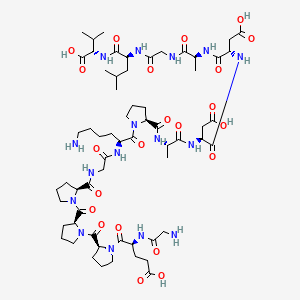
Overview
BPC-157 is a synthetic 15-amino-acid peptide modeled on a reported sequence from a gastric protein. Preclinical research examines tendon-cell migration, outgrowth, and survival under oxidative stress. [1]
Identity
| Compound class | Synthetic peptide |
|---|---|
| Length | 15 amino-acid residues |
| Reference compound | BPC-157 |
| CAS number | 137525-51-0 |
| Molecular formula | C62H98N16O22 |
| Molecular weight | 1419.5 g/mol |
| Source | PubChem CID 9941957 |
Published research
Cell and explant study · Migration versus survival
Investigators measured outgrowth from rat tendon explants and followed individual tendon fibroblasts in culture. They observed greater outgrowth and migration with BPC-157, along with changes in FAK–paxillin signaling, which links cell adhesion to movement. In rat tendon explants and fibroblast cultures, BPC-157 increased cell outgrowth, migration and survival during oxidative stress, with migration accompanied by activation of FAK and paxillin. [1]
Cell study · Growth hormone receptor expression
A later study measured growth hormone receptor expression in tendon fibroblasts after exposure to BPC-157. Receptor abundance gives the cell a possible route to respond differently to a subsequent signal. The researchers found more growth hormone receptor RNA and protein after BPC-157 exposure. Adding growth hormone to the pretreated fibroblasts increased proliferation-associated readouts and activated JAK2. [2]
Where the evidence stands
Rat tendon cells showed two distinct responses: greater migration and survival in one study, and increased growth hormone receptor expression in another. These results support effects on cell movement and responsiveness to growth hormone in the models studied. Mechanical strength was outside the scope of these two cell and explant studies. [1] [2]
Frequently asked questions
What is a pentadecapeptide?
A peptide made up of 15 amino-acid residues.
What is a systematic review?
A review that uses defined search and selection criteria to bring together studies on a specific question.
References
Interested in Researching BPC-157?
View BPC-157 in PURUS Research Catalog.