

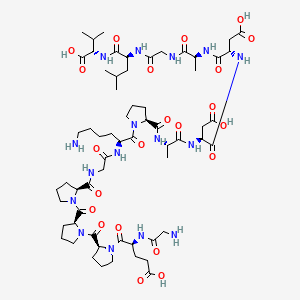


Overview
KLOW contains GHK-Cu, BPC-157, full-length Thymosin Beta-4 (TB4), and KPV. GHK-Cu is studied for collagen synthesis and MMP-2 expression in fibroblast cultures. [1]
Identity
| Material class | Multi-compound blend |
|---|---|
| Components | GHK-Cu, BPC-157, Thymosin Beta-4, KPV |
| CAS number | See individual components |
| Molecular formula | See individual components |
| Molecular weight | See individual components |
| Reference compound | GHK-Cu (neutral 1:1 prezatide copper complex) |
|---|---|
| CAS number | 89030-95-5 |
| Molecular formula | C14H22CuN6O4 |
| Molecular weight | 401.91 g/mol |
| Source | PubChem CID 10111685 |
| Reference compound | BPC-157 |
|---|---|
| CAS number | 137525-51-0 |
| Molecular formula | C62H98N16O22 |
| Molecular weight | 1419.5 g/mol |
| Source | PubChem CID 9941957 |
| Reference compound | Thymosin Beta-4 (full-length peptide) |
|---|---|
| CAS number | 77591-33-4 |
| Molecular formula | C212H350N56O78S |
| Molecular weight | 4963 g/mol |
| Source | PubChem CID 45382195 · CAS cross-reference |
| Reference compound | KPV |
|---|---|
| CAS number | 67727-97-3 |
| Molecular formula | C16H30N4O4 |
| Molecular weight | 342.43 g/mol |
| Source | PubChem CID 125672 |
Published research
GHK-Cu
The copper complex is the constituent examined in the matrix studies. Collagen synthesis measures the production of new protein. MMP-2 and its inhibitors concern the machinery that remodels existing material. These endpoints can change together, so more collagen synthesis in a dish does not reveal the net amount retained in tissue. A study that also included hyaluronic acid tested a different formulation from this blend.
Cell study · Matrix production
GHK-Cu increased collagen synthesis in cultured fibroblasts independently of changes in cell number. [1]
Cell study · Matrix turnover
The researchers found increased MMP-2 and its inhibitors TIMP-1 and TIMP-2, supporting a role for GHK-Cu in matrix remodeling as well as matrix production. [2]
Read the full GHK-Cu overviewBPC-157
The BPC-157 work separates three processes that might otherwise look similar in an explant: cells can move farther, more cells can survive, or cells can become more responsive to another signal. The original experiments used tendon-derived material. Their findings identify properties of BPC-157 in those preparations and provide no direct measurement of how the other ingredients affect those properties.
Cell and explant study · Migration versus survival
In rat tendon explants and fibroblast cultures, BPC-157 increased cell outgrowth, migration and survival during oxidative stress, with migration accompanied by activation of FAK and paxillin. [3]
Cell study · Growth hormone receptor expression
The researchers found more growth hormone receptor RNA and protein after BPC-157 exposure. Adding growth hormone to the pretreated fibroblasts increased proliferation-associated readouts and activated JAK2. [4]
Read the full BPC-157 overviewThymosin Beta-4
KLOW contains the full-length chain. This matters because the binding study identified more than one region that contributes to the interaction with actin. A short central fragment cannot stand in for the full-length molecule in interpreting those experiments. The tissue studies add another level of evidence by measuring events in intact rat wounds. They did not test the other KLOW constituents alongside thymosin beta-4.
Biochemical study · How the chain binds actin
The investigators found actin-interacting residues in both the N-terminal region and the central six-residue motif of full-length thymosin beta-4. [5]
Rat skin-wound study
Compared with saline controls, treated rat wounds showed 42% greater re-epithelialization on day four, alongside increased collagen deposition and new vessel formation. [6]
Read the full Thymosin Beta-4 overviewKPV
KPV is the three-residue constituent of KLOW. Its epithelial-cell studies asked how a small peptide enters a cell and how that cell responds to an inflammatory stimulus. A transporter result concerns entry, whereas nuclear movement of a signaling protein concerns what happens inside the cell. The distinction matters when comparing the intestinal and bronchial experiments or interpreting their relevance to a mixture.
Cell and animal study · Uptake and inflammatory signaling
The investigators found that PepT1 transported KPV into cells, where it reduced inflammatory signaling and cytokine release, and reported reduced intestinal inflammation in mouse models. [7]
Cell study · A second epithelial model
The authors found that KPV interfered with nuclear entry of the NF-κB subunit p65 and reduced inflammatory signaling in stimulated bronchial epithelial cells. [8]
Read the full KPV overviewWhere the evidence stands
For KLOW, the component studies support matrix-related responses for GHK-Cu, tendon-cell responses for BPC-157, actin binding and rat tissue-repair findings for full-length thymosin beta-4, and reduced inflammatory signaling for KPV. The experiments used different cells, animals and endpoints. No study cited here tested all four constituents together or established an additive or synergistic effect. [1] [2] [3] [4] [5] [6] [7] [8]
Frequently asked questions
How do I read a blend reference?
Check whether the paper characterized the complete mixture, an individual compound, or an analytical method.
Can a blend name establish its chemical identity?
A scientific identity depends on a defined composition and the evidence for that composition.
References
- GHK-Cu and collagen synthesis in fibroblast cultures | FEBS Lett, 1988
- GHK-Cu and MMP-2 in fibroblast cultures | Life Sci, 2000
- Tendon-cell migration and survival | J Appl Physiol (1985), 2011
- Growth hormone receptor expression in tendon fibroblasts | Molecules, 2014
- Thymosin β4 actin-binding study · 1996
- Rat skin-wound study | J Invest Dermatol, 1999
- KPV transport and intestinal inflammation | Gastroenterology, 2008
- KPV inflammatory signaling in bronchial epithelial cells | Int J Physiol Pathophysiol Pharmacol, 2012
Interested in Researching KLOW?
View KLOW in PURUS Research Catalog.